
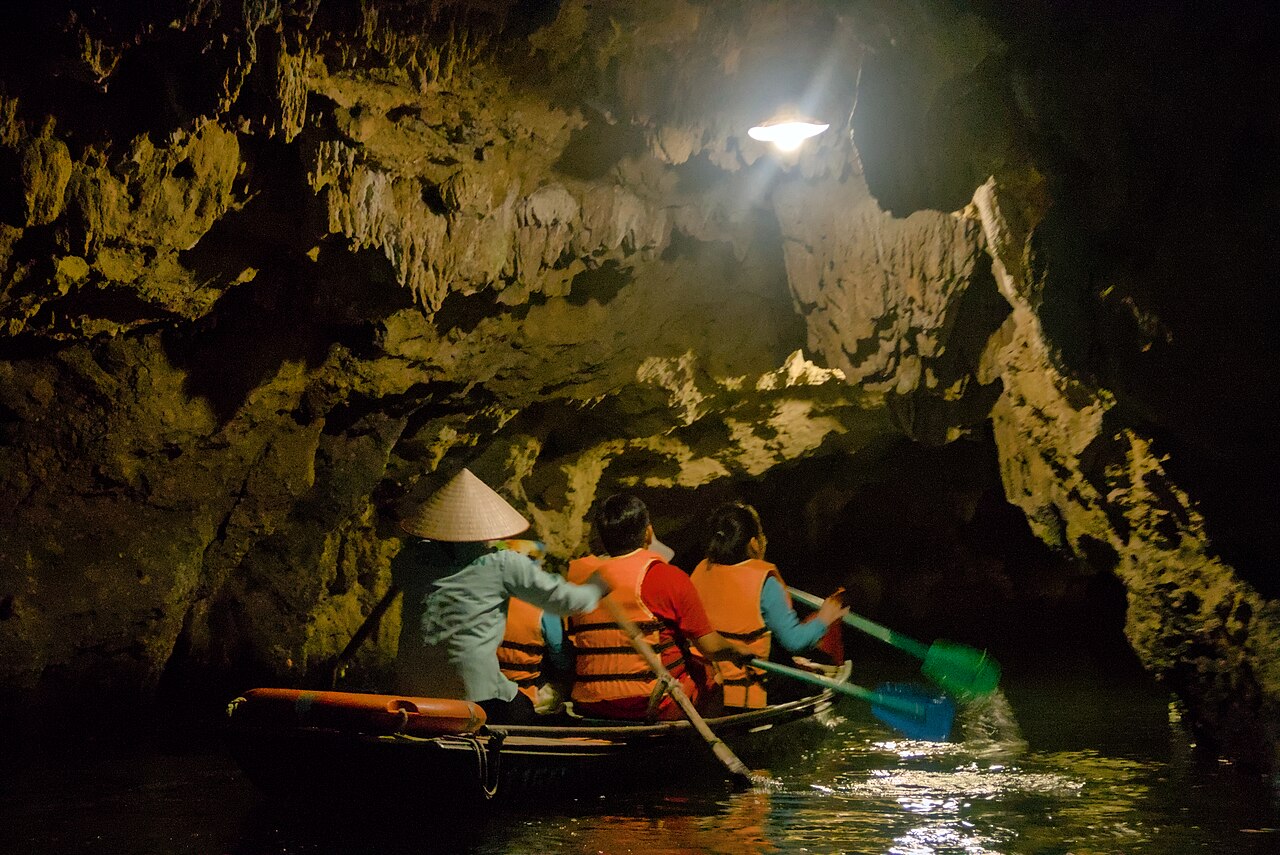
Ninh Binh is a region in northern Vietnam where steep limestone towers rise straight out of flat green rice fields, and slow rivers wind between them and through caves. It is often called a land of dry bays, and it is easy to see why. This guide explains the main places, how to move between them, and how to see them gently rather than in a rush.

A landscape of limestone and water
Ninh Binh sits south of the Red River delta, where the flat farmland suddenly gives way to dramatic limestone hills. The hills stand alone, steep and green, like islands in a sea of rice. Rivers curve around their feet and sometimes pass straight through them in low caves. The town of Ninh Binh itself is modest, with about 160,000 residents, and it works as a convenient base for exploring the countryside around it.

Why the scenery looks this way
The towers are karst, a landscape formed when slightly acidic rainwater slowly dissolves limestone over a very long time. Caves, hollows and sharp-sided hills are the result. Here, the process left a field of separate peaks that can be explored by water. You do not need to know geology to enjoy it, but a little background makes the boat ride more meaningful. When you pass through a cave, you are traveling through a hill that rain and time have hollowed out.
Trang An by boat
The Trang An area is about seven kilometers from town and is the best-known boat ride in the region. The trip lasts more than two hours, and the boats glide through a series of caves, past temples and across quiet lagoons. Many of the tunnels have been widened for boats, though the first two are more natural and tight, so keep your head down. UNESCO listed the Trang An Landscape Complex in 2014 for both its natural and cultural value. Bring water, wear a hat and sit back.
Tam Coc and its three caves
Tam Coc lies about nine kilometers south of the town. Boats take visitors along a river through three caves, the longest of them around 125 meters, between rice fields and limestone towers. It is the busiest of the boat-tour areas, so go early in the morning or late in the afternoon, when the air is cooler and the light is softer. Some boats carry handicrafts for sale. A polite no is enough if you are not interested, and a smile goes a long way.
The oarsmen and the quiet
Rowers in this region work hard, often for many trips a day. Some row with their feet, a skill that has become part of the local image. Be kind to them: sit still, follow their instructions about life jackets and balance, and give a fair tip if you were pleased with the trip. The most memorable moments on the water are often silent ones, when the oars stop and you can hear birds and water dripping from the cave roof.
Hoa Lu, the ancient capital
About six kilometers north of Ninh Binh lies Hoa Lu, the capital of Vietnam during the Dinh dynasty from 968 and the early Le dynasty until 1009. Most of the ancient city has been lost, but temples dedicated to the kings still stand against the limestone hills, and the tomb of Dinh Tien Hoang lies on a hillside. Hoa Lu is not grand in the way that some historic sites are. It is small, quiet and good for understanding the early story of an independent Vietnam.
Bich Dong Pagoda
Not far from Tam Coc, Bich Dong is a group of three temples carved into the side of a limestone mountain, dating from the fifteenth century. A short climb takes you from the lower temple up to the top, where the view over the fields is lovely, especially near sunset. Dress modestly, remove your shoes where signs ask, and keep your voice low. Entrance is generally free, but donations are welcome and parking arrangements vary, so look for the official area.
Hang Mua and the viewpoint
The Mua Cave viewpoint is a climb of several hundred stone steps to a small temple and a high platform with sweeping views over the river and rice fields. The climb is steep in places and has little shade. Start early, take water and rest at the landings. Do not hurry. Avoid the midday hours, when the steps can be hot and crowded, and be careful on wet stone after rain. The view at the top is worth the effort.
Cuc Phuong National Park
About 45 kilometers from the town, Cuc Phuong National Park protects well-preserved tropical forest, with ancient trees, caves and a primate rescue center that works with endangered species. A guide is required for some areas, and the best chance of seeing animals is at night on a guided tour. Butterflies are most numerous in April and May. It is a quieter alternative to the boat areas, and a good choice if you want a day among trees rather than rivers.
Getting there
Buses run regularly from Hanoi's southern bus station to Ninh Binh, and the trip takes roughly one and a half to two and a half hours depending on traffic. A private car or taxi is more expensive but more flexible, and many hotels in Hanoi can arrange transfers. Trains also serve Ninh Binh station. Check schedules in advance, and allow time for traffic on the way back, especially at weekends. Our guide to the <a href="https://www.brightermornings.online/2026/08/19/hanoi-old-quarter-walking-guide/">Hanoi Old Quarter</a> is a good starting point before you head south.
Getting around
The main sights are close enough to reach by bicycle or electric bike, and the flat country roads are pleasant in the morning. Motorbikes can be rented, but traffic on the main road is fast, so only ride if you are experienced and have a helmet. If you prefer not to ride, hotels can arrange a driver for the day. Whichever you choose, carry water, a map and a rain jacket in the wet months.
Seasons and the colors of the fields
Northern Vietnam has a cool, damp winter and a hot, humid summer. The rice fields are bright green during the growing season and turn golden shortly before harvest, and local people can tell you when the best time is in any given year. Mist is common in the cooler months and can make the hills look like a painting. Summer is hotter, so start early. Check the weather before you book a boat, since heavy rain can affect operations.
What to eat
Ninh Binh has its own specialties. Goat meat is a regional favorite, usually served grilled, steamed or in a stew, and crispy rice is eaten with rich sauces. Sample local dishes in small restaurants rather than tour-group places. If you do not eat meat, ask for vegetarian options, and say so politely. Fresh fruit, herbal tea and sweet snacks are easy to find in the markets.
Where to stay
Options range from simple guesthouses in town to homestays and small hotels in the countryside. A stay close to the fields lets you see the morning mist and hear the village wake. Ask about transport, since country locations may be a bike ride from the sights. Book ahead for weekends and holiday periods, and ask your host for suggestions on quiet routes. If the weather is hot, make sure the room has good air conditioning and screens.
A slow day in Ninh Binh
- Early morning: cycle to the river and take a boat trip before the crowds arrive.
- Late morning: visit Bich Dong Pagoda and sit in the shade.
- Midday: eat lunch at a family restaurant and rest.
- Afternoon: climb to the Mua Cave viewpoint when the heat has eased.
- Evening: watch the fields glow as the sun sets, then have a simple dinner.
Visiting kindly
The fields are people's livelihoods. Do not walk into the rice, pick crops or fly a drone near workers. Take your rubbish with you, avoid single-use plastic and ask before photographing people. Support the families who live and work here by buying meals and small items locally, and speak softly in temples and caves. A gentle visitor leaves the place as quiet as it was found.
Find it on the map
- Check opening hours, boat rules and weather on the day.
- Wear a hat, bring water and use sun protection.
- Wear shoes with grip for the viewpoint steps.
- Agree on prices before you start a boat trip or a rental.
- Check the weather and any local news the day before, and read recent Google Maps reviews for current conditions.
- Carry water, sun protection and small change, and wear comfortable shoes.
- Dress modestly for temples and shrines: shoulders and knees covered.
Take your time. Do not hurry from one stop to the next. Sit down, look slowly, and let yourself appreciate what is in front of you. A place seen slowly is remembered for much longer.
Edited by Rehel Jemera Sausa


